
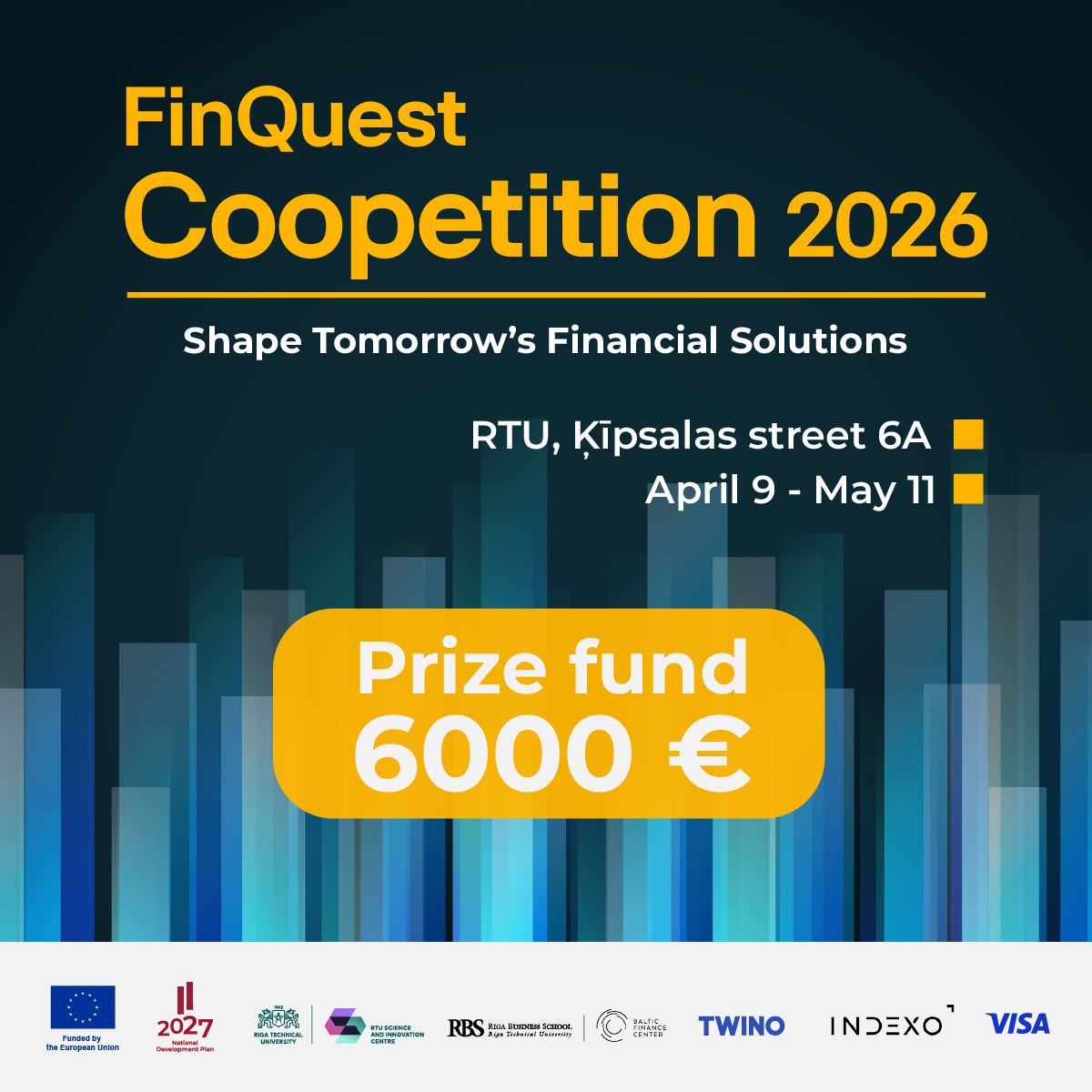
FinQuest Coopetition 2026 is an interdisciplinary innovation challenge empowering students, emerging professionals, and innovation enthusiasts to create impactful solutions for the future of financial services. Through exclusive guided workshops, mentoring, and hands-on prototyping, participants will work in teams to develop innovative, sustainable, and human-centered ideas aligned with the European Union’s financial policy goals.
The Coopetition is Organized by the Baltic Finance Centre of Riga Technical University (RTU) Riga Business School in collaboration with RTU Design Factory.
Challenges
Applicants must select one of the three challenge areas:



Participation
- Apply via the registration form, select a challenge, and briefly describe your idea.
- Team size: 3–5 pers. (Individuals also may apply but must form a team by the end of Prototyping Day)
- Participants with any background and from any country are welcome (except Russia and Belarus).
- Teams must attend the full event and follow the regulations.
- All sessions take place in person at RTU, Ķīpsalas iela 6A, Riga (The Moon) from 16:00–19:00
Evaluation & Awards
- Teams will present a prototype or concept in a 3-minute pitch + Q&A.
- One winning team will be selected per challenge category based on relevance, innovation, feasibility, progress, and presentation quality.
- Award eligibility: 2/3 of team members must attend 80%+ of activities and present the final pitch.
Prize Fund
- EUR 6,000 total— EUR 2,000 for each challenge winner
- Additional RTU Design Factory Award for outstanding collaboration
Important Notes
- Registration closes on March 16, 2026, at 23:59 (EEST). UPDATE! Application deadline for INDEXO challenge extended till March 19, 23:59 (EEST)!
- Any information shared publicly during the event is treated as public knowledge.
- The working language of the Coopetition is English.
Event Schedule
Choose your challenge
Challenge Owner

Challenge Owner

Challenge Owner

What we expect from teams
About the solution
Teams are invited to design any type of solution that helps take concrete steps towards solving the problem. We intentionally do not prescribe a specific format or business model to encourage broad and creative thinking.
Depending on your chosen challenge, your solution may take many forms, including but not limited to:
- Digital platforms or ecosystems;
- Mobile or web applications;
- Standalone tools or features;
- Onboarding, verification, or decision-support journeys;
- Comparison, discovery, or recommendation mechanisms;
- Counterparty, offer, or transaction validation mechanisms;
- Digital learning solutions;
- Hybrid solutions combining various formats.
Solutions can differ by target user and delivery model: they may be consumer-facing or B2B-oriented, and either embedded within existing services or offered as standalone concepts. Both early-stage ideas and more developed prototypes are welcome.
Success criteria
- Relevance & Impact: How well does the solution address the challenge?
- Innovation & Creativity: How original and innovative is the solution compared to existing approaches?
- Feasibility: How realistic and technically achievable is the solution with current resources, knowledge, and technology?
- Viability: How likely is the solution to succeed in the market and deliver value to customers or stakeholders?
- Presentation & Communication: How effectively the team conveys its idea during the pitch.
Regulation
Teams are not expected to analyse regulatory frameworks, licensing requirements, or legal barriers in detail. The focus should be on solving the problem, even if it is unclear how the solution may fit under the current regulations.
For any questions, please contact: mara.robezniece[at]rbs.lv