
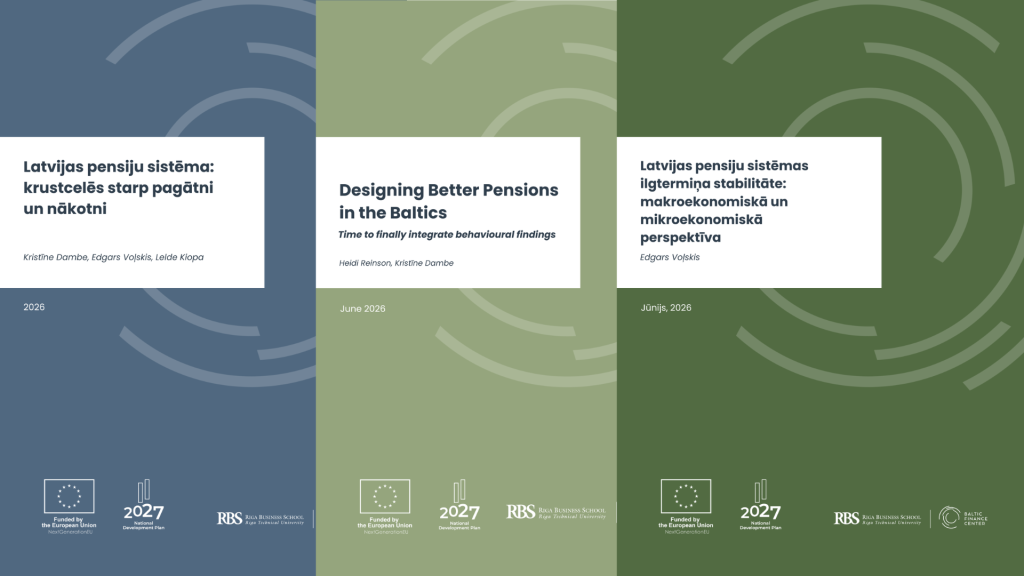
The Baltic Finance Centre has published three new policy papers offering a comprehensive analysis of the development, sustainability and future challenges of pension systems in Latvia and across the Baltic States. The papers provide evidence-based recommendations for policymakers, highlighting opportunities to strengthen people’s financial security in retirement.
The policy paper “Latvia’s Pension System: At the Crossroads Between the Past and the Future” (Kristīne Dambe, Edgars Voļskis and Lelde Kiopa) examines the evolution of Latvia’s pension system over the thirty years since the landmark 1995 reform. The authors conclude that Latvia has developed one of the most fiscally sustainable pension systems in the European Union. However, its most significant challenge remains the inadequacy of pension income and the high risk of poverty among older people. The paper puts forward recommendations for improving all three pension pillars and strengthening the governance of the pension system.
The second paper “Designing Better Pension Systems in the Baltic States” (Heidi Reinson, Kristīne Dambe) explores the role of behavioural economics in shaping retirement savings outcomes. It examines how default options, the presentation of information, reminders, incentives, barriers and trust influence people’s decisions about saving for retirement. Drawing on examples from Latvia, Estonia, Lithuania and other countries, the paper identifies which approaches are most effective, which are less successful, and why.
The third paper, “The Long-Term Sustainability of Latvia’s Pension System: Macroeconomic and Microeconomic Perspectives” (Edgars Voļskis), assesses the long-term sustainability of Latvia’s pension system based on socioeconomic and demographic projections through to 2070. It analyses alternative scenarios for allocating social insurance contributions between the first and second pension pillars, evaluating their impact on both public finances and the adequacy of future pensions. The paper also considers how different choices regarding participation in the second and third pension pillars may affect individuals’ retirement income.
Together, these three policy papers aim to support the development of evidence-informed pension policy at a time when population ageing, demographic change and economic uncertainty are placing increasing pressure on pension systems to remain both financially sustainable and capable of providing adequate income in old age.